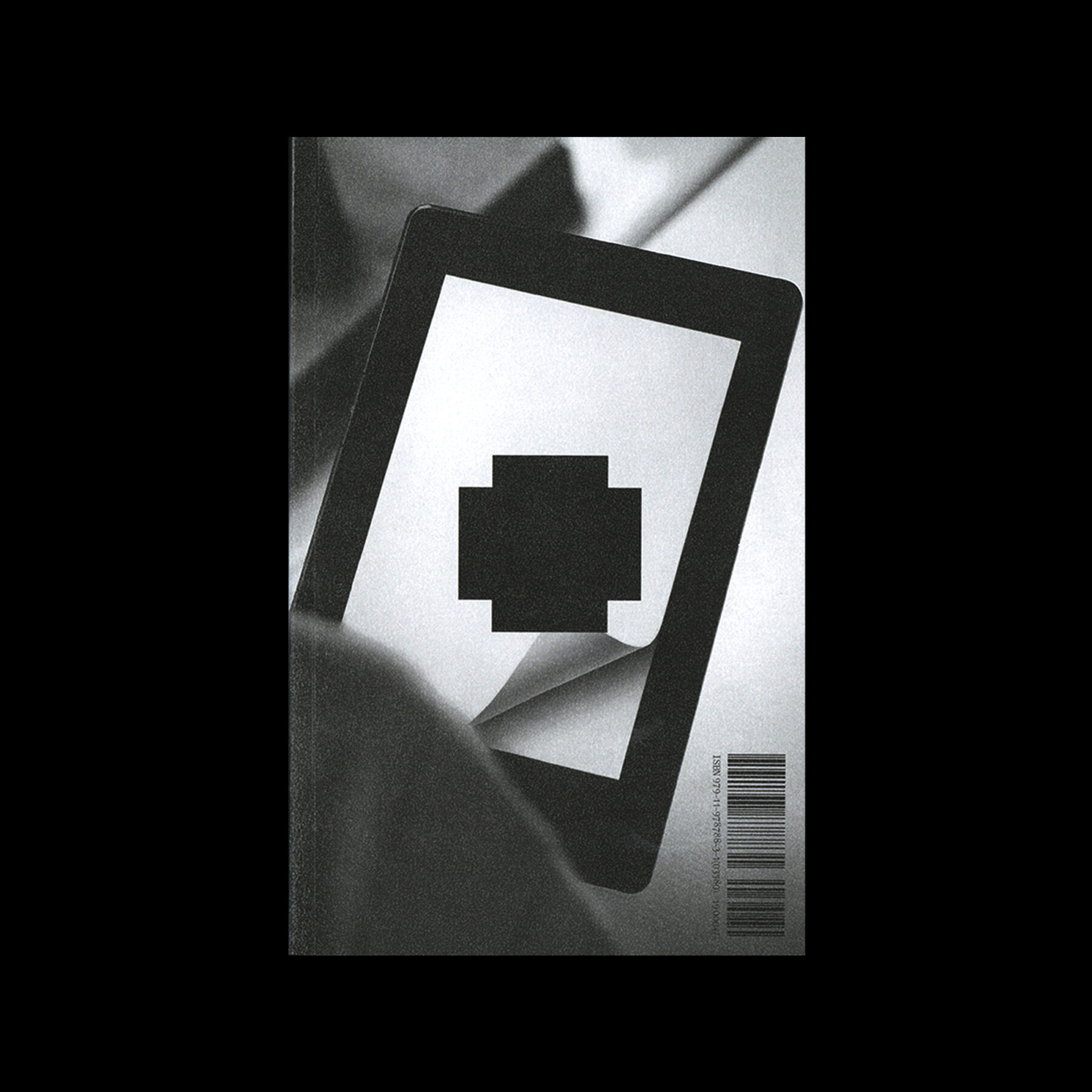
‘자유로운 문서 포맷’의 본질Learning from Free Document Format
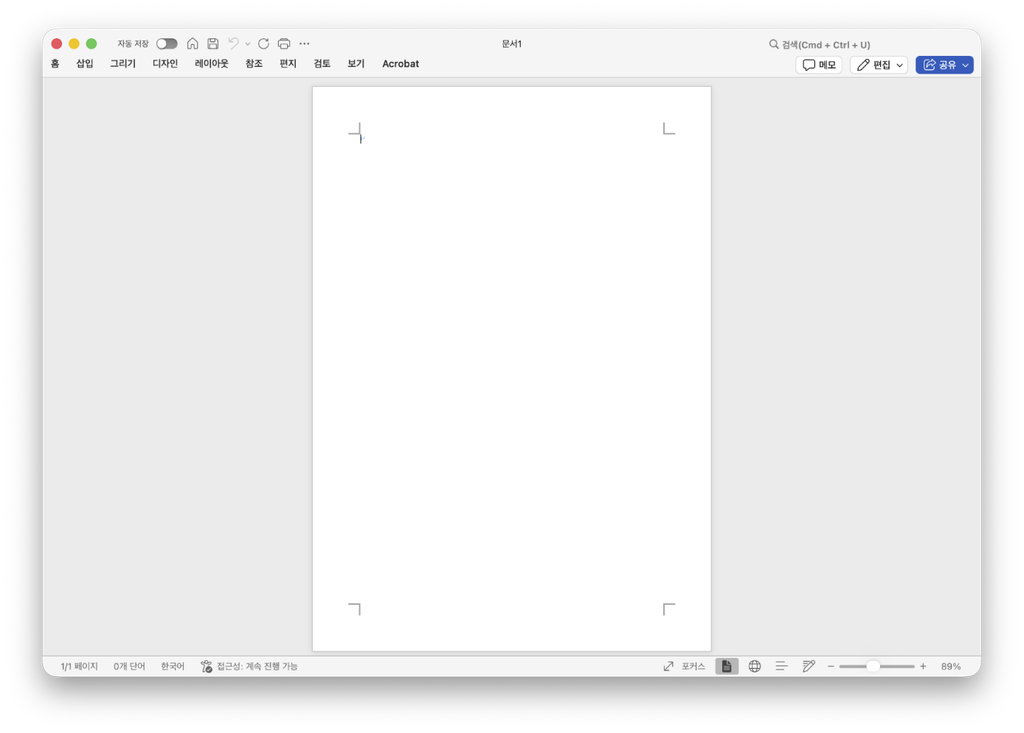
문서 편집 프로그램 속 가상의 하얀 종이.
‘문서’(document)를 떠올려 보자. 곧바로 네모나게 재단된 흰 종이가 떠올랐다면, 과연 이것이 우리가 하루 종일 다루는 ‘문서’인지 한번 생각해 보자. 오늘날 대부분의 문서는 문서 작성(혹은 편집) 프로그램 안에 가상의 하얀 프레임에서 탄생한다. 이 매끈한 직사각형은 우리가 일반적으로 알고 있던 하얀 종이 문서의 ‘페이지’(page)를 웹상에 그대로 옮긴 것이다. 그러나 웹은 종이와 매우 다른 환경이다. 종이는 한 장 한 장 넘기며 읽어야 하고, 물리적인 크기에서 한계가 있어 레이아웃(layout) 자체도 고정적이다. 반면 웹은 스크롤을 통해 끝없이 페이지가 추가될 수 있고, 디지털 스크린의 종류에 따라서도 비율과 크기가 달라질 수 있다.
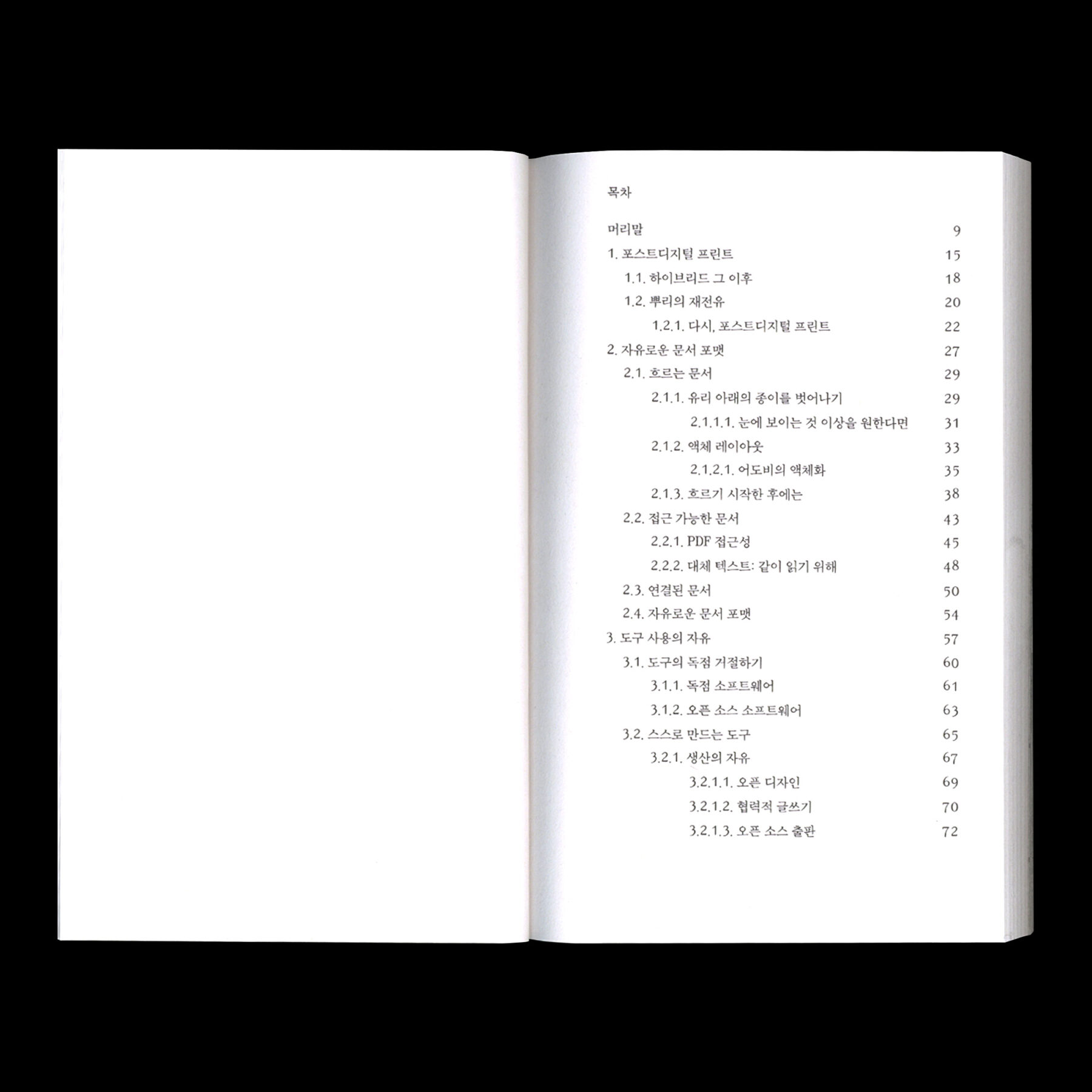
‘자유로운 문서 포맷(Free Document Format)’은 디지털 환경의 문서가 분명 인쇄된 종이 문서와 다른 특징을 갖고 있는데, 정작 이것이 디지털 환경의 고유한 특성을 반영하지 않는다는 문제의식에서부터 출발한다. 저자가 상상하는 ‘자유로운 문서 포맷’은 종이책의 페이지 개념에 기반한 기존 문서의 고정관념에서 벗어난, 디지털의 특징을 적용한 새로운 문서의 형태이다. 유연성, 접근성, 연결성을 하위 범주로 포함한다. (이 글에서는 이 세 가지 하위 요소를 상세히 설명하지 않지만, 월드 와이드 웹(World Wide Web)의 특성이 문서의 형식 자체에 반영된 것이라 이해할 수 있겠다.)
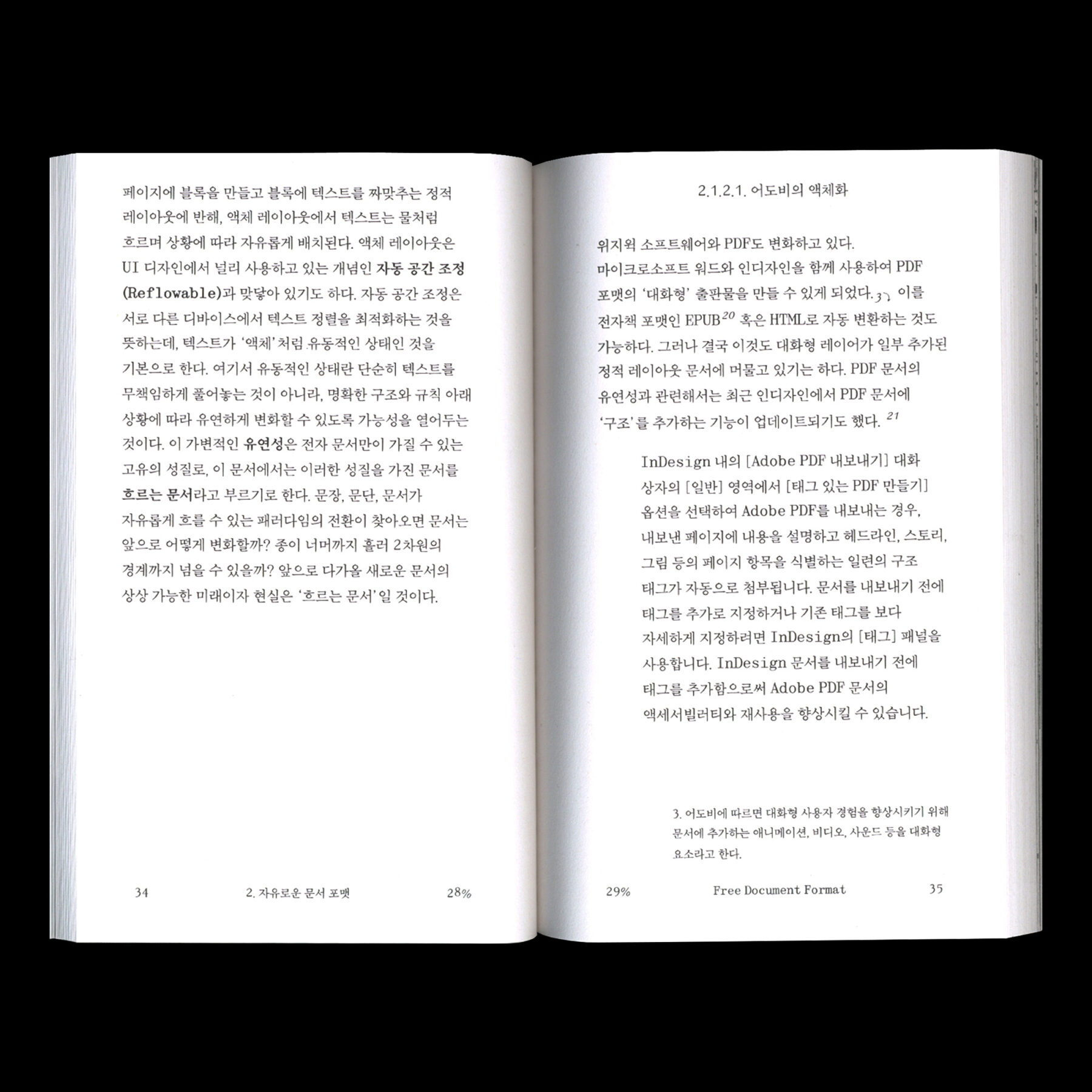
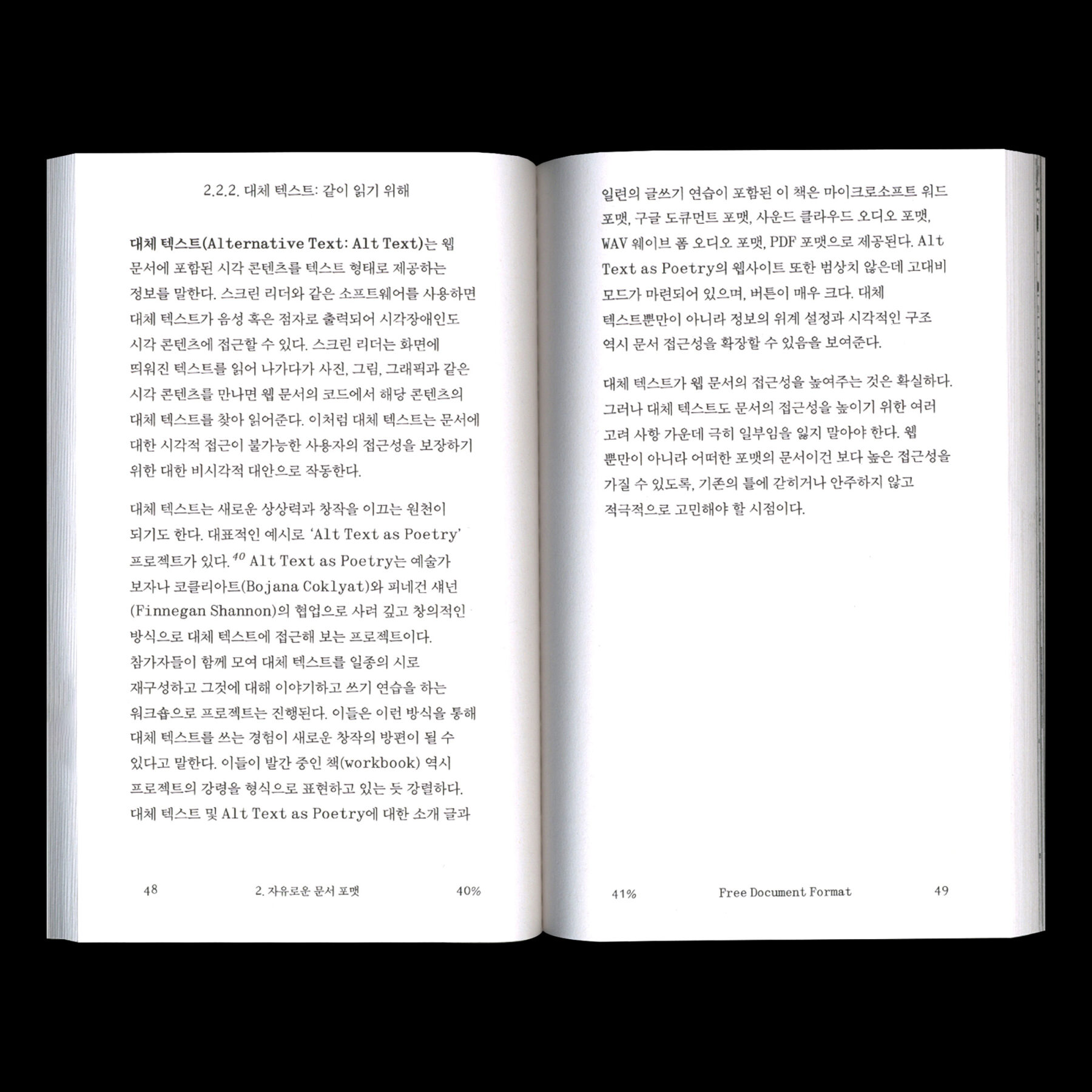
결론적으로 ‘자유로운 문서 포맷’은 세 가지 특징으로 종합할 수 있다. 첫째, 전 세계 표준화된 서식과 구조에 기반한 설계를 통해 어디서나 문서를 호환할 수 있다. 둘째, 비율과 크기가 고정된 종이 기반 레이아웃에서 해방된다. 디지털 콘텐츠는 장치나 플랫폼에 따라 자동으로 디자인을 조정하며 마치 액체처럼 유동적으로 흐른다. 셋째, 하이퍼텍스트(hypertext) 등 디지털 네트워크의 속성을 이용하여 문서와 문서, 텍스트와 텍스트를 서로 연결한다.
어떤 것이 존재하는 형태를 새롭게 상상하는 것은 다소 쉽지 않은 작업이다. 단순히 외양만 갈아 끼우는 게 아니라, 그것을 만드는 도구와 제작 방식, 더 나아가 근본적인 개념까지도 다시금 생각해 보아야 하기 때문이다. 저자는 스스로 다음과 같이 질문을 던진다.
문서를 작성하고, 형식을 만들고, 공유하고 읽는 과정을 더욱 유기적으로 연결할 수는 없을까? 왜 주어진 도구를 단지 수용하면서 사용해야 할까? 반복적인 작업을 더 효율적으로 해결할 방법이 있지 않을까? ①❶김다빈, 『자유로운 문서 포맷』, (서울: AABB, 2024), 10.
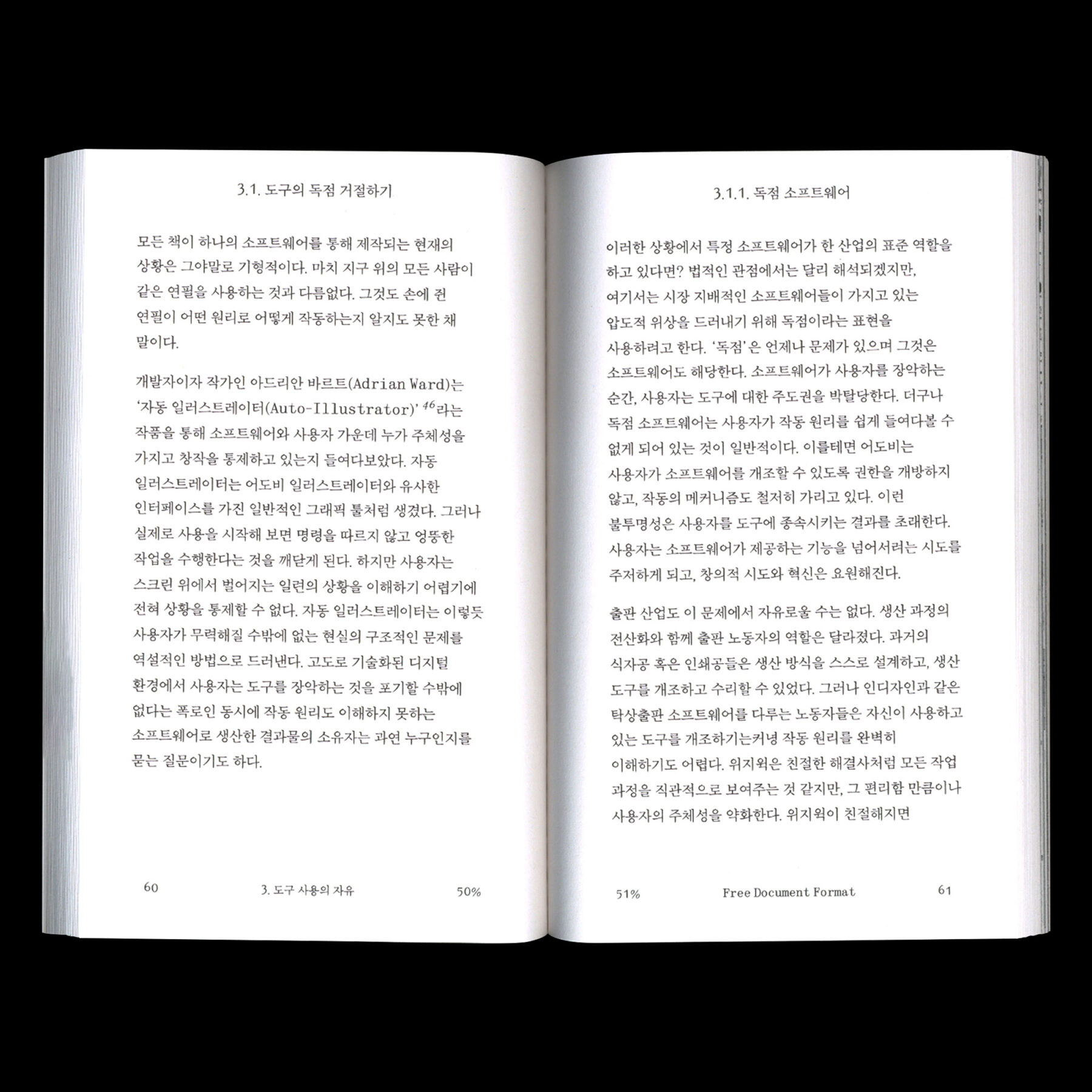
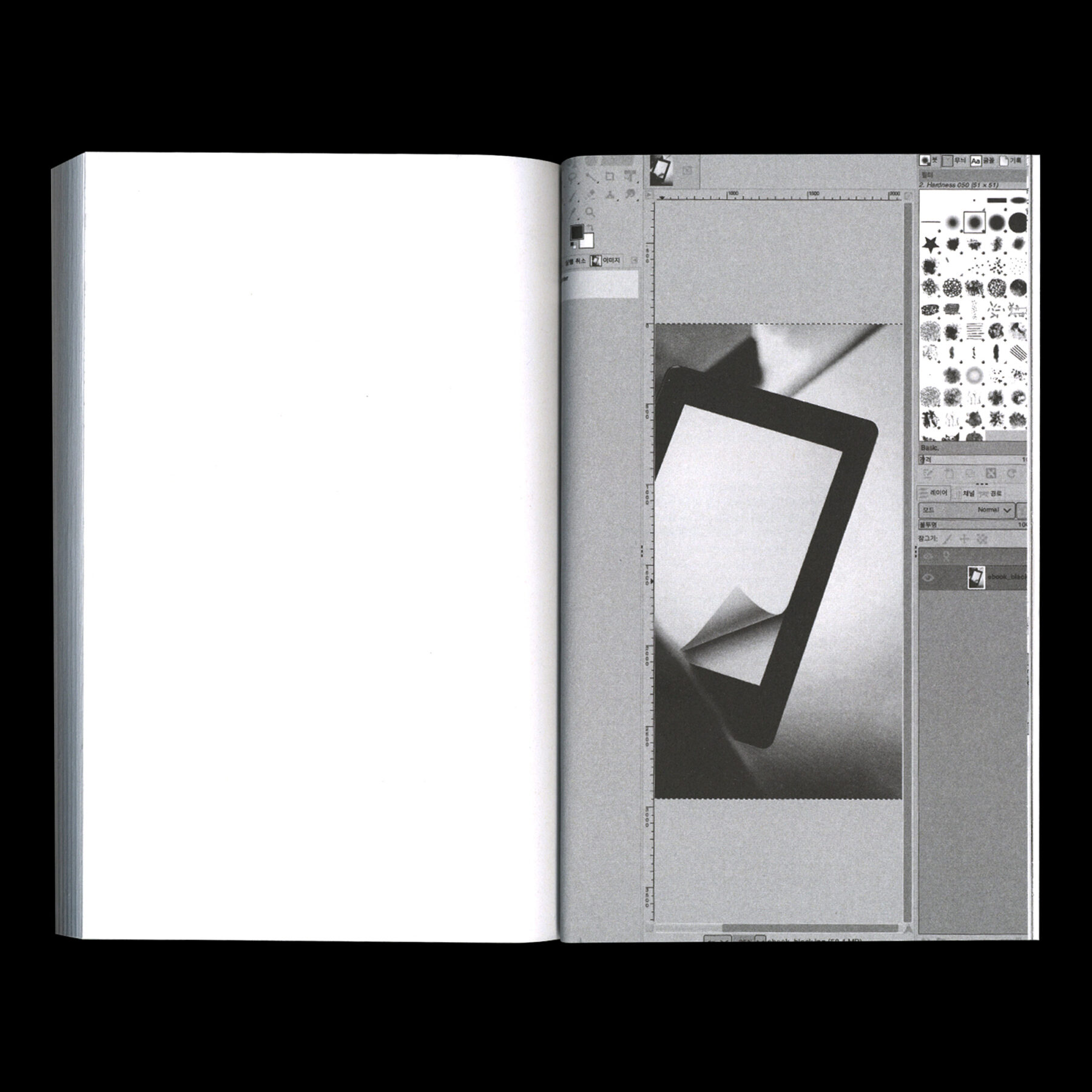
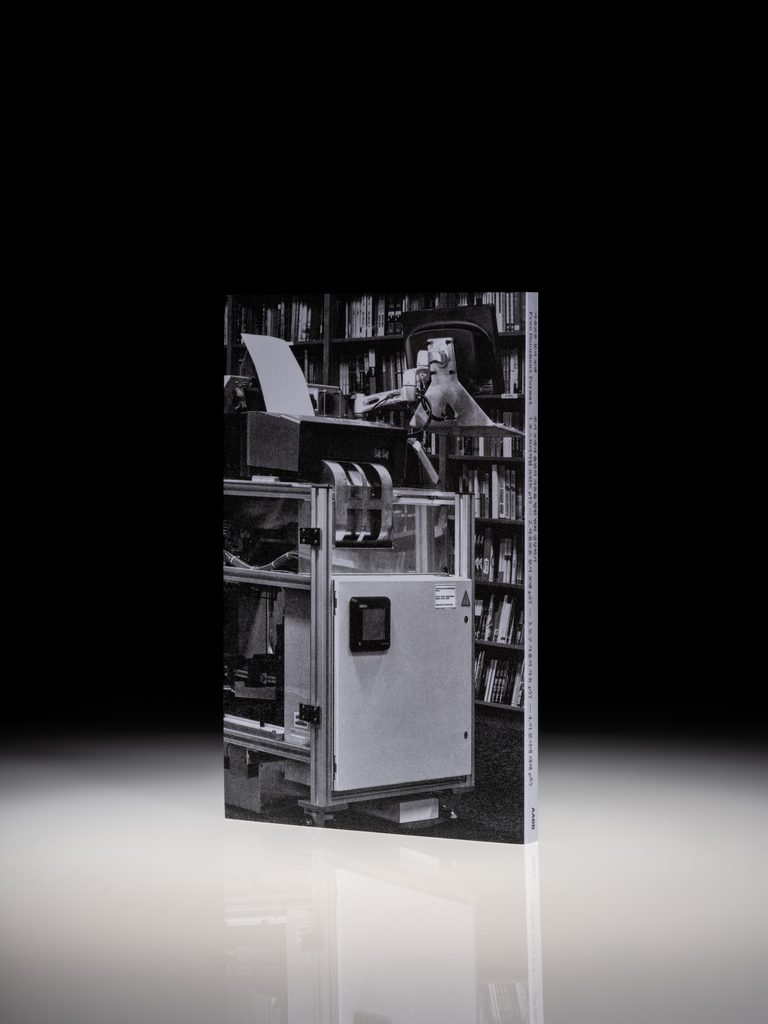
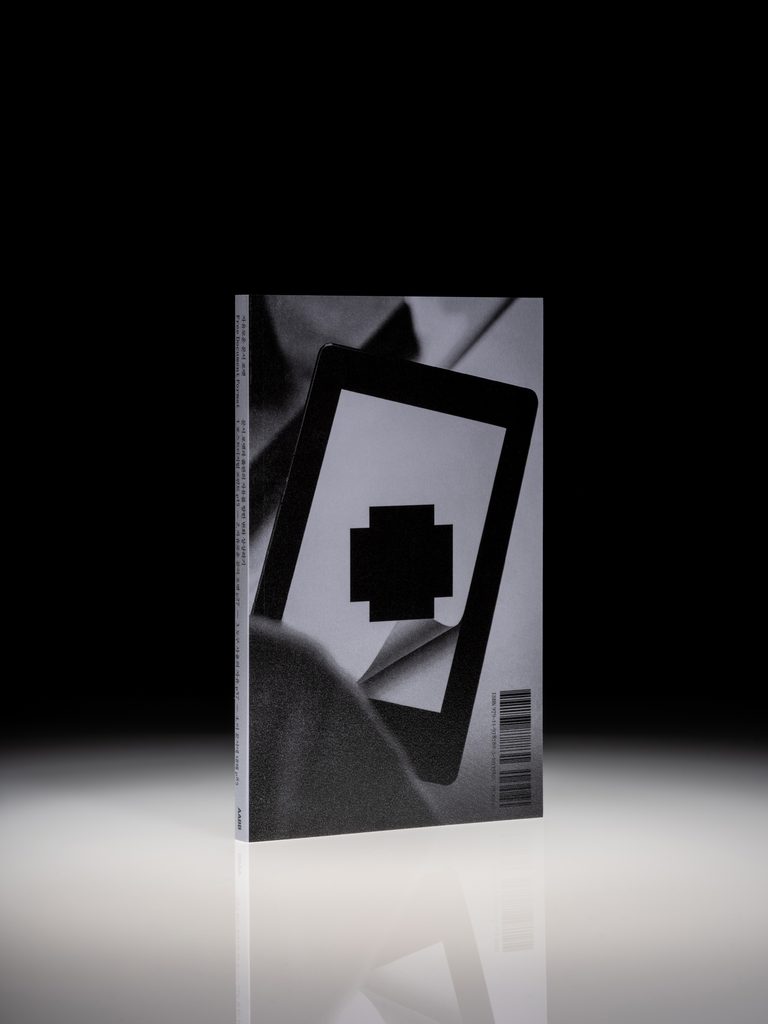
저자는 이 책을 만드는 과정에도 이 질문을 적용했다. 단일한 소프트웨어가 거의 독점하다시피 하는 현재의 일반적인 책 만들기 도구에서 벗어나, 새로운 도구와 방식을 적용하여 출판한 것이다. 『자유로운 문서 포맷』의 작성과 조판에는 판독(Pandoc), Paged.js, 스크라이버스(Scribus), 김프(Gimp) 등의 오픈 소스 소프트웨어와 마크업 코드가 활용되었다. 책의 텍스트 자체도 html 기반의 웹 문서로 열람하거나 Git 저장소의 패키지 형식으로 다운로드 가능한 오픈 소스이다.
위와 같이 이 책은 내용의 차원에서는 포스트 디지털 시대의 문서 포맷과 출판을 상상하고, 형식의 차원에서는 ‘자유로운 문서 포맷’을 직접 실험했다. 이 실험의 의의는 동시대 출판의 형태를 다루었다는 점에도 있지만, 필자는 저자가 이 책을 통해 보여준 주체적인 태도 자체도 유의미하다고 본다. 『자유로운 문서 포맷』은 디자이너로서 스스로가 속한 환경과 다루는 도구를 비판적으로 사유한 프로젝트다. 이러한 시도는 오늘날 더욱 가치를 발한다. 생성형 인공지능의 발전으로 도구의 숙련도를 높이는 데 들이는 시간이 점점 줄어들고 있는 현재, 익숙한 환경에 반(反)하여 지속적으로 질문을 던지는 태도가 오히려 점점 중요해지고 있기 때문이다. 도구의 사용이 쉬워질수록 역설적으로 도구에 종속될 가능성이 높아진다. 그러므로 ‘새로운 문서 포맷과 출판의 형태는 어떤 모습이어야 할까?’라는 책 전체를 관통하는 질문은 여전히 유효하고, 이에 대한 답으로 ‘자유로운 문서 포맷’을 상상해 나가는 저자 나름의 과정 역시 시간이 지나도 그 가치를 잃지 않는다.
Translated automatically into English via AI agent.
The virtual white page of a document-editing program.
Think of a “document.” If the first thing that comes to mind is a rectangular sheet of white paper, it is worth asking whether that is really the kind of “document” we spend our days working with. Today, most documents begin inside writing or editing programs, within a virtual white frame. This smooth rectangle is essentially the familiar “page” of a paper document carried over onto the web. But the web is a very different environment from paper. Paper is read one page at a time, and its physical dimensions place fixed limits on the layout. On the web, however, a page can extend almost endlessly through scrolling, while its proportions and dimensions can change depending on the screen on which it appears.
The idea of a “Free Document Format” begins from a critical awareness: digital documents clearly work differently from printed ones, yet their formats rarely reflect the unique possibilities of the digital environment. The “Free Document Format” imagined by the author proposes a new form of document that moves beyond conventions based on the pages of printed books and instead makes use of the characteristics of digital media. It encompasses flexibility, accessibility, and connectivity as its subcategories. (While this essay does not discuss these three principles in detail, they can be understood as an attempt to incorporate the characteristics of the World Wide Web into the form of the document.)
Ultimately, the Free Document Format can be understood through three key characteristics. First, documents remain compatible anywhere, as they are built on globally standardized formats and structures. Second, they are freed from paper-based layouts with fixed proportions and dimensions. Digital content can automatically adapt to different devices and platforms, flowing like liquid rather than remaining fixed to a single page. Third, the features of digital networks, including hypertext allow documents to connect with other documents and texts to connect with other texts.
Imagining a new form for something that already exists is not an easy task. It requires more than simply changing its appearance; it also means reconsidering the tools used to make it, the way it is produced, and ultimately the fundamental ideas behind it. The author asks:
Could the processes of writing, formatting, sharing, and reading documents be connected more organically? Why should we simply accept and use the tools we are given? Could there be a more efficient way to handle repetitive tasks? ①❶Dabin Kiim, Free Document Format (Seoul: AABB, 2024), 10.
The author applied these same questions to the making of the book itself. Rather than relying on the single piece of software that dominates conventional bookmaking, the author used alternative tools and methods to make the book. Free Document Format was written and typeset using open-source software and markup, including Pandoc, Paged.js, Scribus, and GIMP. The text of the book itself is also open source: it can be read as an HTML-based web document or downloaded as a package from a Git repository.
In this way, the book imagines document formats and publishing for the post-digital era through its content while putting the “Free Document Format” into practice through its own form. The significance of this experiment lies partly in its exploration of contemporary publishing, but what I find equally meaningful is the self-directed stance of questioning and rethinking familiar tools.. Free Document Format critically examines the environment and tools the author works with as a designer. This kind of approach feels increasingly relevant today. As generative AI reduces the time it takes to develop proficiency with tools, the willingness to question familiar working environments may become more important than ever. Paradoxically, the easier tools become to use, the easier it may also become to depend on them without questioning how they shape our work. The question that runs throughout the book—“What should new forms of documents and publishing look like?”—therefore remains relevant. So too does the author’s process of imagining the “Free Document Format” as one possible answer, a process whose value is unlikely to fade with time.
Writer
고현경Hyun Go
시각디자인을 전공하고 예술학 석사 과정에서 미술출판을 연구하고 있다. 디지털 시대의 출판을 다룬 『디지털 네트워크로 출판하기』(AABB, 2025), 문화사 속 숨겨진 출판의 역사를 발굴한 『Do or DIY』(미디어버스, 2026)의 저자이자 디자이너다.Hyun Go holds a BFA in Visual Communication Design and is currently pursuing an MA in Art Studies with a focus on art publishing in Korea. She is the author and designer of Publishing Through Digital Networks (AABB, 2025), a self-initiated project on publishing in the digital age, and the bilingual Korean-English edition of Do or DIY (Mediabus, 2026).