협업의 연성 조건The Unwritten Conditions of Collaboration
부끄부끄①❶부/끄/부/끄는 서울을 기반으로 활동하는 이동식 도서관이다. 온라인에서는 쉽게 접하기 어려운 고유한 영감과 정보를 큐레이션해 오프라인 이벤트와 콘텐츠를 통해 소개하고, 누구나 부담 없이 지식을 나누고 관계를 맺을 수 있는 열린 공유의 장을 지향한다. 멤버 구성은 김용식, 장재혁, 필자인 한지은으로 이루어져 있다.라는 이름으로 이동식 도서관을 운영한 지도 어느덧 2년. 얼레벌레 여러 일을 벌이고, 어떻게든 하나씩 마무리해 오다 보니 어느새 사업자등록까지 하게 됐다. 뚜렷한 대의나 명분도, 이렇다고 할 수익도 없는 상태에서 시작한 일이 사업자등록으로 이어질 줄은 처음 이 일을 시작했을 때만 해도 미처 상상하지 못했다. 일과 재미의 경계 어딘가에서 무언가 함께 도모해 보자며 막연하게 시작한 일이지만, 눈앞의 이익과는 거리가 먼 고생을 이어가다 보면 문득 ‘대체 왜, 무엇을 위해 이 일을 함께하고 있는가’라는 질문으로 미끄러질 때가 있다.
여전히 그런 질문들에 시원한 답을 내놓지 못하는 와중에도, 합이 맞는 동료를 만나는 일이 여간 어려운 일이 아니라는 것만은 분명히 알고 있다. 취향이 비슷한 사람들을 만나는 것과, 그 안에서 함께 무언가를 꾸준히 도모할 수 있는 사람을 만나는 것은 또 다른 문제이기 때문이다. 느슨한 합의로 시작한 관계가 팀이 될 수 있었던 것은 아마도 비슷한 크기의 마음으로 크고 작은 일들을 함께 해내며 자연스럽게 신뢰를 쌓아왔기 때문일 것이다. 그렇기에 함께할 수 있는 팀원이 있다는 사실만으로 ‘이 일을 왜 하는가’와 같은 불확실한 질문들은 잠시 잊게 된다. 그렇게 굳이 이유를 찾자면 ISBN이 있는 책을 만들어보고 싶어서 작성한 간소한 사업자등록증 서류에 세 팀원이 나란히 서명했고, 딱히 달라질 것도 없겠지만 앞으로도 한동안 함께하게 될 것임을 암시하는 종이 한 장은 왠지 모를 든든함을 더해주는 것도 같았다.
이동식 도서관 부끄부끄는 장소를 옮겨가며 몇 차례의 임시 도서관을 열었고, 방문자가 가져온 책을 다른 책과 1:1로 교환하는 방식으로 운영해 왔다. 처음엔 사실 내심 다들 버릴 책을 들고 오지 않을까 걱정했는데, 의외로 자신에게 정말 좋았던 책을 내놓는 사람들이 많았다. 그렇게 교환된 책들을 통해 낯선 누군가의 서가를 엿보고 경험하는 일은 우리에게도 큰 보람이었고, 도서관을 찾는 사람들 역시 그런 경험을 하기를 바랐다. 그 과정에서는 서로에게 책과 작품을 추천하고 추천받는 일도 자연스럽게 이어진다. 얼마 전에도 도서관을 운영하며 알게 된 한 지인이 “강연금을 보지 않은 사람과는 겸상할 수 없다”라며 강력하게 추천한 덕분에 뒤늦게 『강철의 연금술사』를 읽게 되었는데, 왜 그토록 권했는지 단번에 알 것 같을 만큼 근래 본 작품 중에 가장 큰 재미와 여운이 남았다.
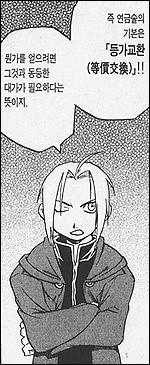
금기시된 연금술로 몸을 잃은 형제가 자신의 몸을 되찾기 위해 떠나는 여정을 그린 『강철의 연금술사』는 ‘무언가를 얻으려면 그에 상응하는 대가를 치러야 한다’라는 등가교환의 법칙을 세계의 기본 전제로 제시한다. 하지만 주인공 형제는 그 법칙을 누구보다 믿고 따르려 하면서도 결정적인 순간마다 기꺼이 손해를 감수하는 선택을 한다. 이러한 일화들을 통해 작품이 끝내 이야기하고자 하는 것은, 세상을 살아가는 데 필요한 등가교환의 법칙도 사람과 사람 사이의 진실한 마음 앞에선 아무것도 아닌 것이 된다는 점이다. 이는 우리 세상의 법칙과도 어느 정도 닮아 있는 듯하다. 이동식 도서관 역시 1:1 교환이라는 형식을 따르고 있지만, 정작 우리가 기대하는 것은 정량적으로는 측정하기 어려운 우연한 만남인지도 모른다.
『의향서들』은 사적인 애정과 공적인 노동이 자연스럽게 교차하는 예술계의 특수한 관계성을 섬세하게 드러내는 책이다. 다다(Dada)와 플럭서스(Fluxus)의 네트워크형 출판물, 출판을 작품의 기록이 아닌 새로운 실천과 협업을 촉발하는 매개체로 확장한 한스 울리히 오브리스트(Hans Ulrich Obrist)의 참여형 프로젝트이자 출판물 《Do It》 등 동료 사이의 네트워킹을 일종의 선언문과 같은 예술로 승화한 작업은 종종 접해왔지만, 관계가 형성되는 과정에서 오가는 미묘한 감정과 아직 이름 붙일 수 없는 관계의 상태까지 투명하게 기록한 작업은 잘 본 적이 없었다.
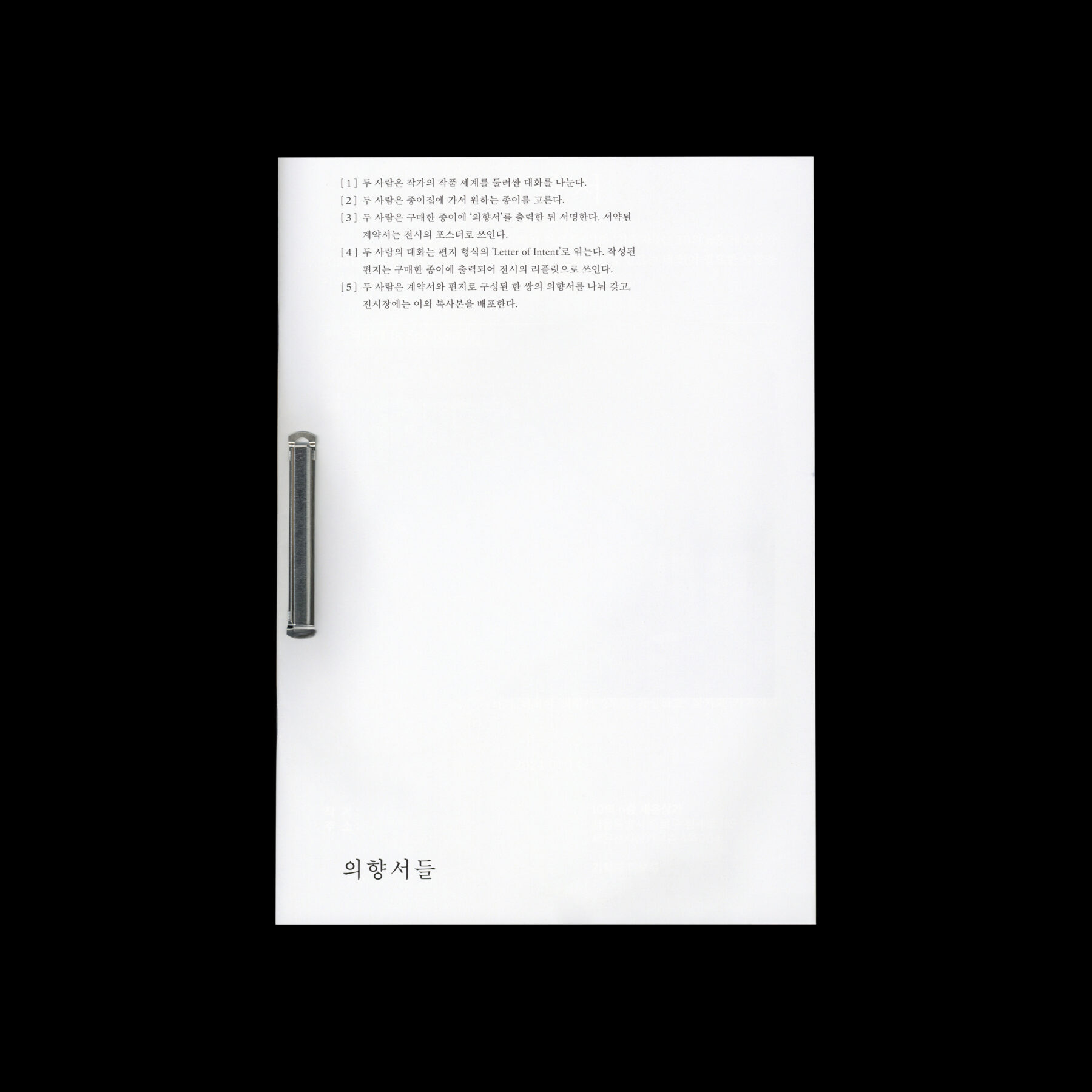
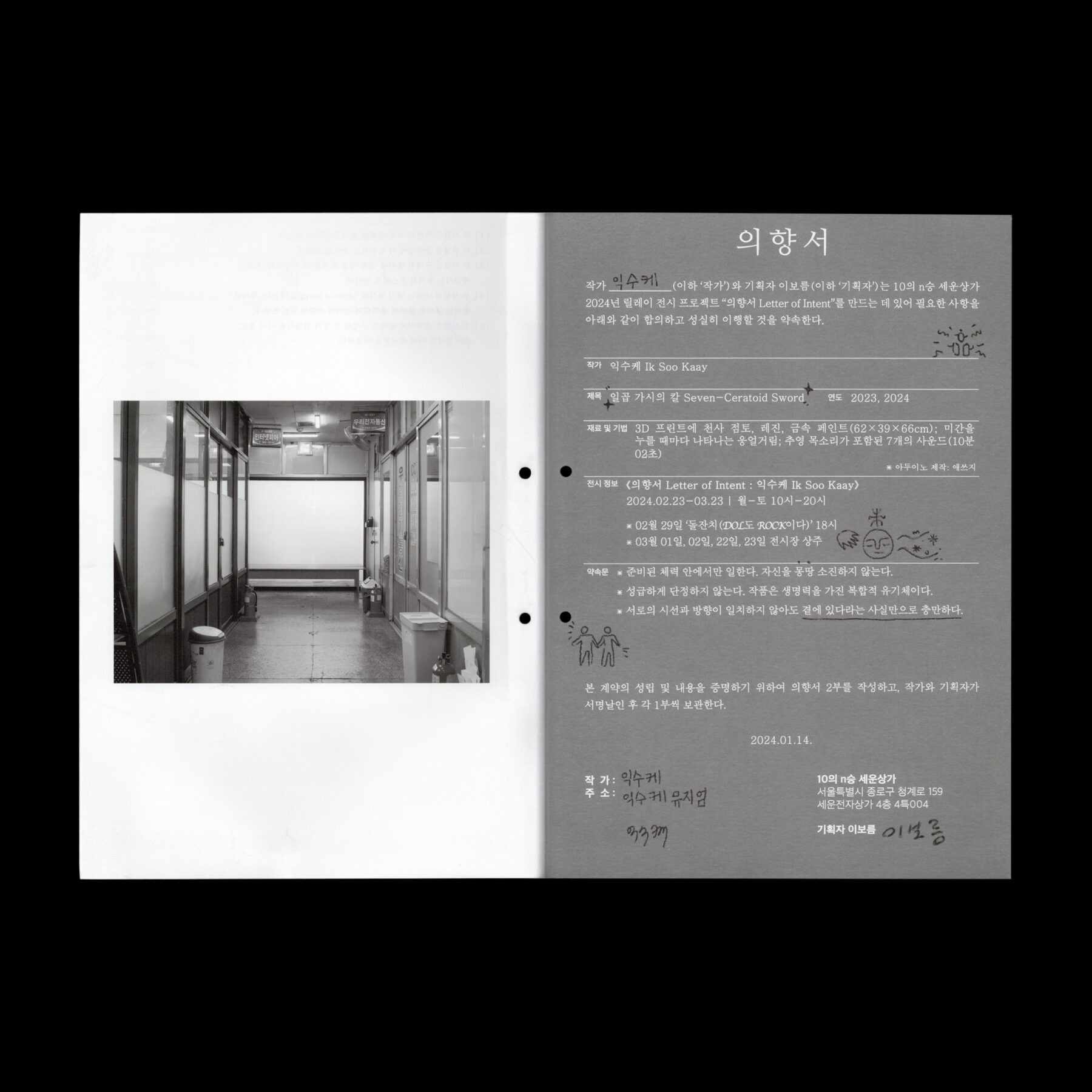
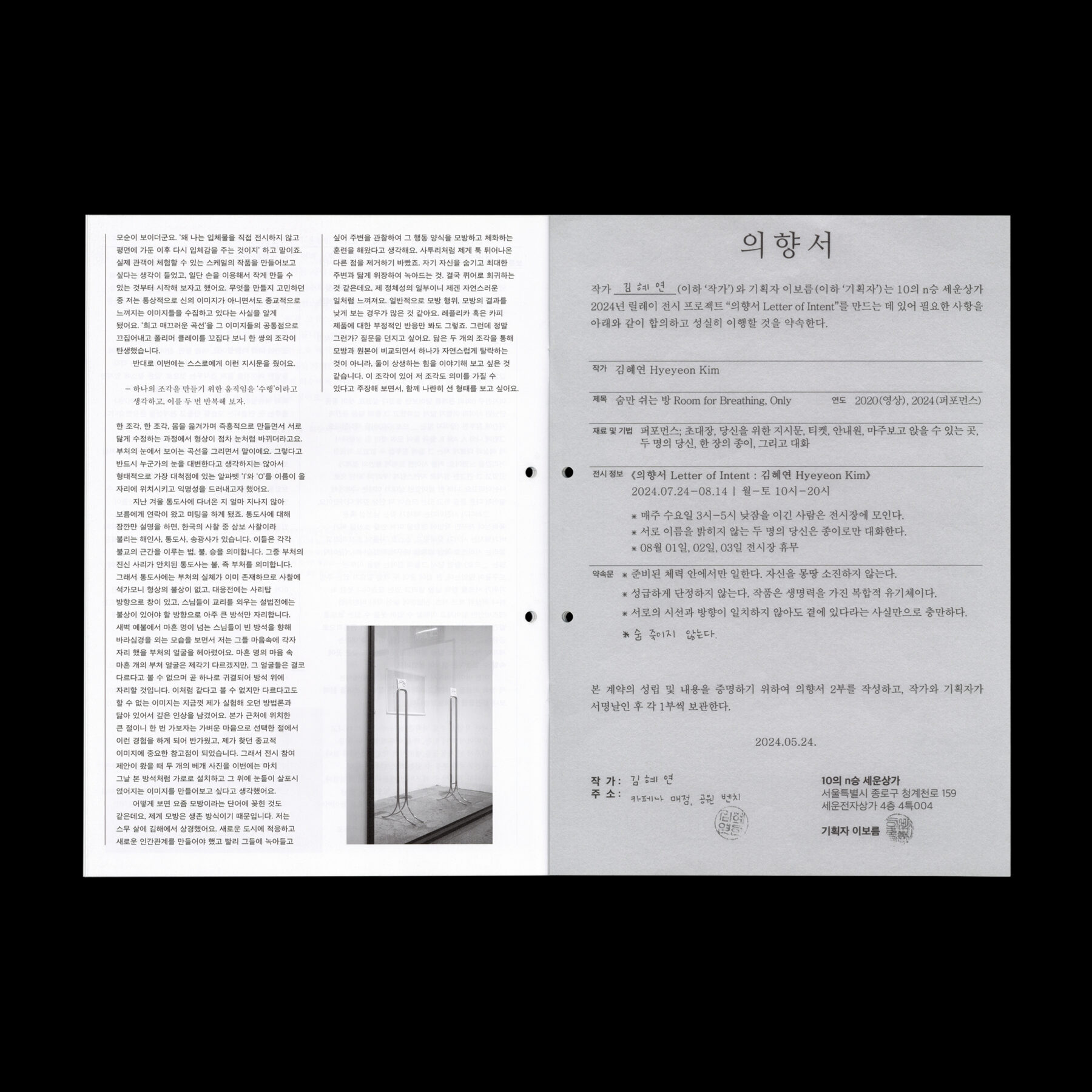
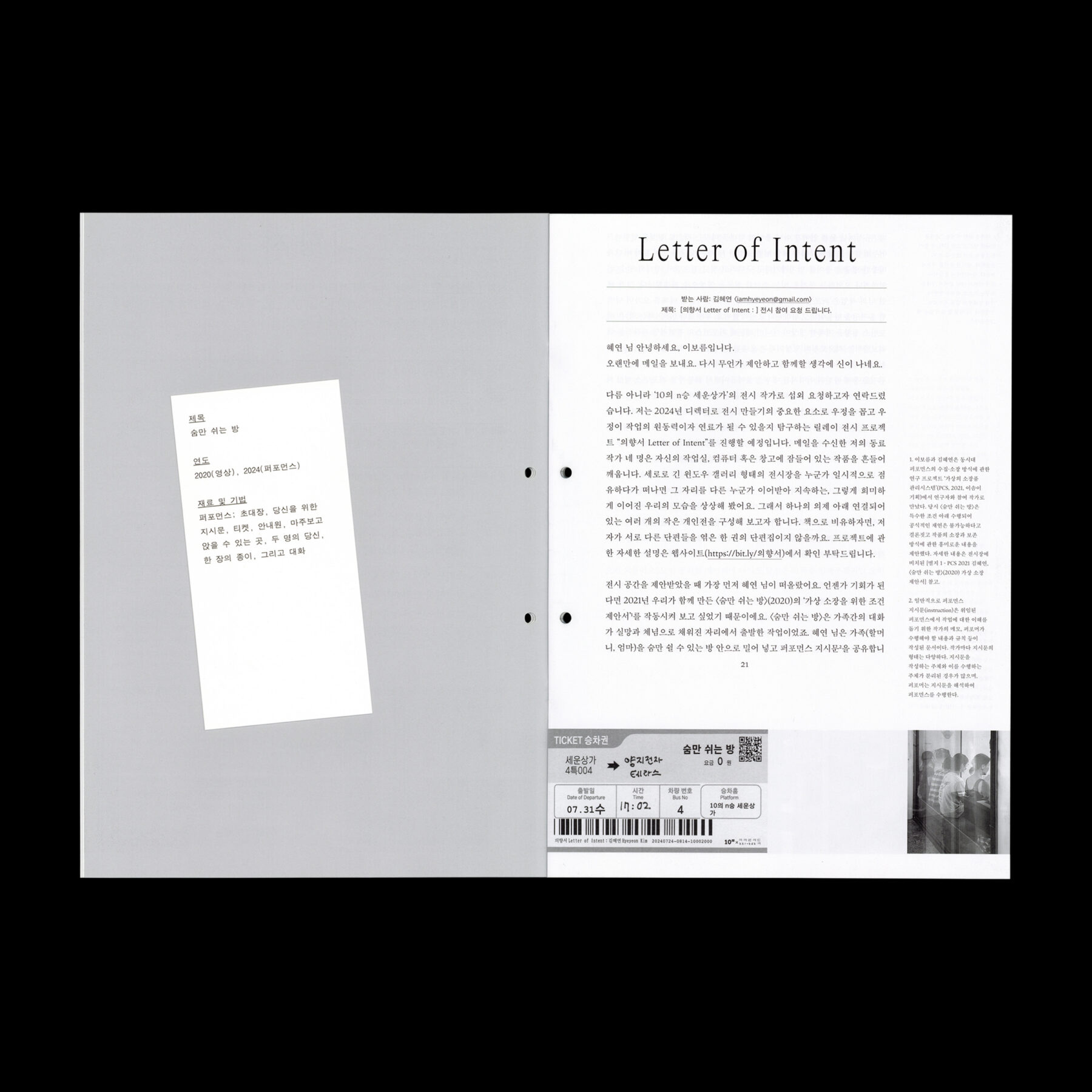
책의 구성은 단순하다. 표지의 매뉴얼에서부터, 전시를 위해 큐레이터와 네 명의 작가(익수케, 최희수, 김혜연, 이빈소연)가 함께 작성한 의향서 네 장을 중심으로, 작가를 섭외하는 과정에서 오간 메일, 작가와의 대화록, 실제 전시 전경, 그리고 독자가 직접 작성해 볼 수 있는 빈 의향서 양식이 차례로 이어진다.
무엇보다 이 책의 의도를 잘 보여주는 것은 섭외와 협업의 과정에서 계약 이전에 구두로 오가곤 하는 의향과 기대, 서로를 향한 약속을 문서의 형식으로 남겼다는 점일 것이다. 이 책의 저자이자 큐레이터 이보름은 큐레이터와 작가 간의 ‘공모적 우정’을 서류와 편지 그 어느 사이에 위치시키려는 의도와 계약 이전의 ‘의향’이라고 부르는 모호한 감정과 상태에 주목해 주로 부동산이나 투자 분야에서 본격적인 계약을 맺기 전, 참여 의사를 밝히기 위해 작성되는 문서인 ‘의향서’라는 포맷을 활용했다. 여기서 의향서는 법적 효력을 갖는 계약서는 아니지만, 말로 쉽게 흩어질 수 있는 관계의 시작을 기록하고 가시화하는 장치로 기능한다. 따라서 의향서에는 보통의 계약서에서는 보기 힘든 약속의 문장이 담겨있다.
“준비된 체력 안에서만 일한다. 자신을 몽땅 소진하지 않는다.”, “성급하게 단정하지 않는다. 작품은 생명력을 가진 복합적 유기체이다.”, “서로의 시선과 방향이 일치하지 않아도 곁에 있다는 사실만으로 충만하다.”
이처럼 함께 노동하는 사람들이 서로에게 건네는 다짐에 가까운 약속문은 금전적인 조건이나 계약 관계를 넘어, 관계가 어떤 조건 위에서 서로를 돌보고 지탱하며 유지되는지를 보여준다.
이어지는 ‘섭외 메일’이자 동시에 ‘편지’인 글들은 큐레이터로서 전시를 제안하는 전문적인 노동과, 오랫동안 네 작가의 작업을 지켜봐 온 사람만이 품을 수 있는 애정 어린 관찰, 그리고 섬세한 해석이 촘촘하게 교차하며 사적인 영역과 공적인 영역이 자연스럽게 맞닿는 지점을 또 한 번 드러낸다. 전시 섭외 과정에서 오간 대화는 메일이라는 다소 공적인 형식으로 옮겨지지만, 그 안에는 관계를 향한 편지의 온기가 고스란히 남아 있다. 메일의 말미에는 최소한의 여비를 제외하고는 무상으로 전시에 참여해주기를 바란다는 ‘참고 사항’이 조심스럽게 덧붙여지는데, 이는 이들의 협업이 단순한 계약 관계를 넘어 서로에 대한 신뢰와 공모적 우정 위에서 이루어지고 있음을 자연스럽게 드러낸다.
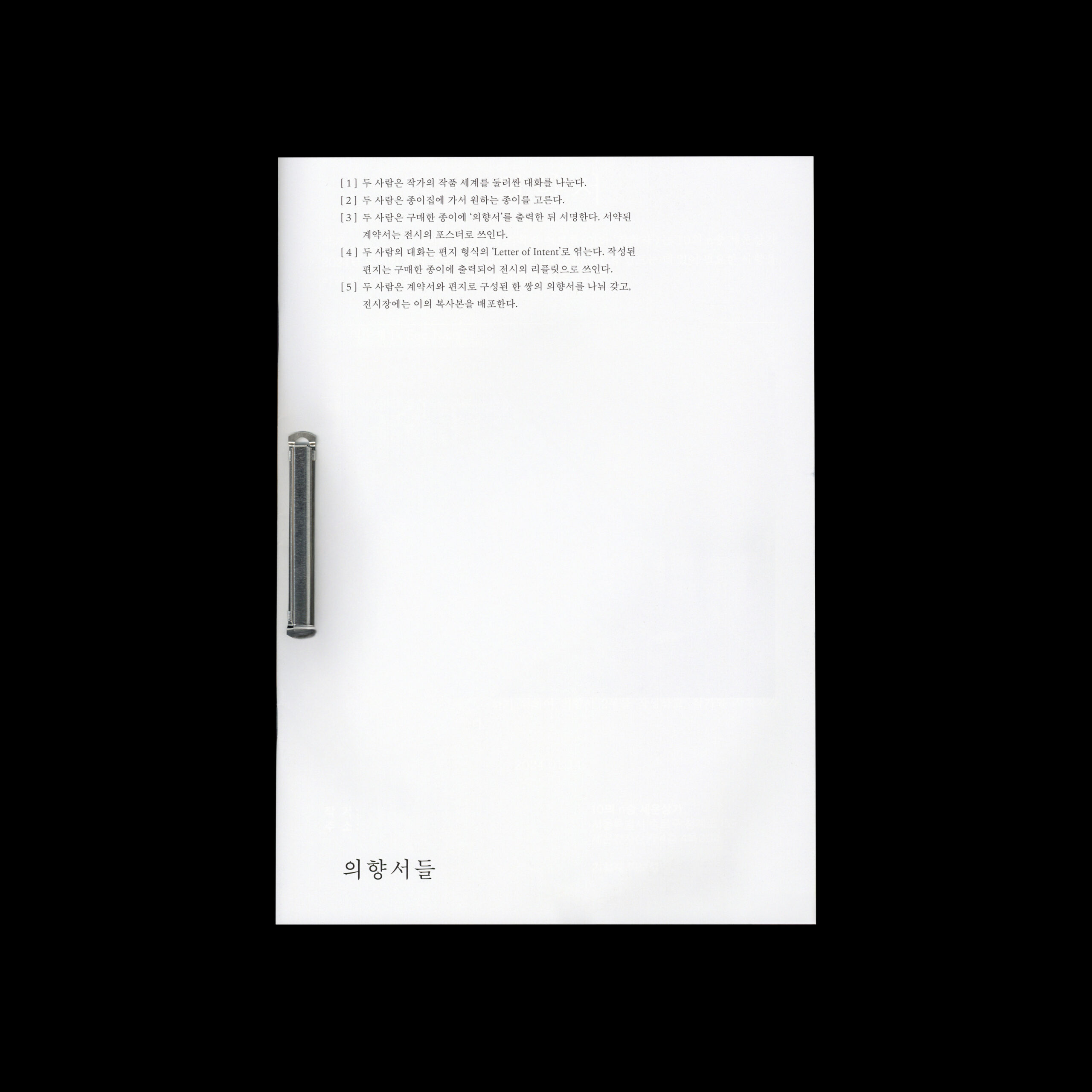
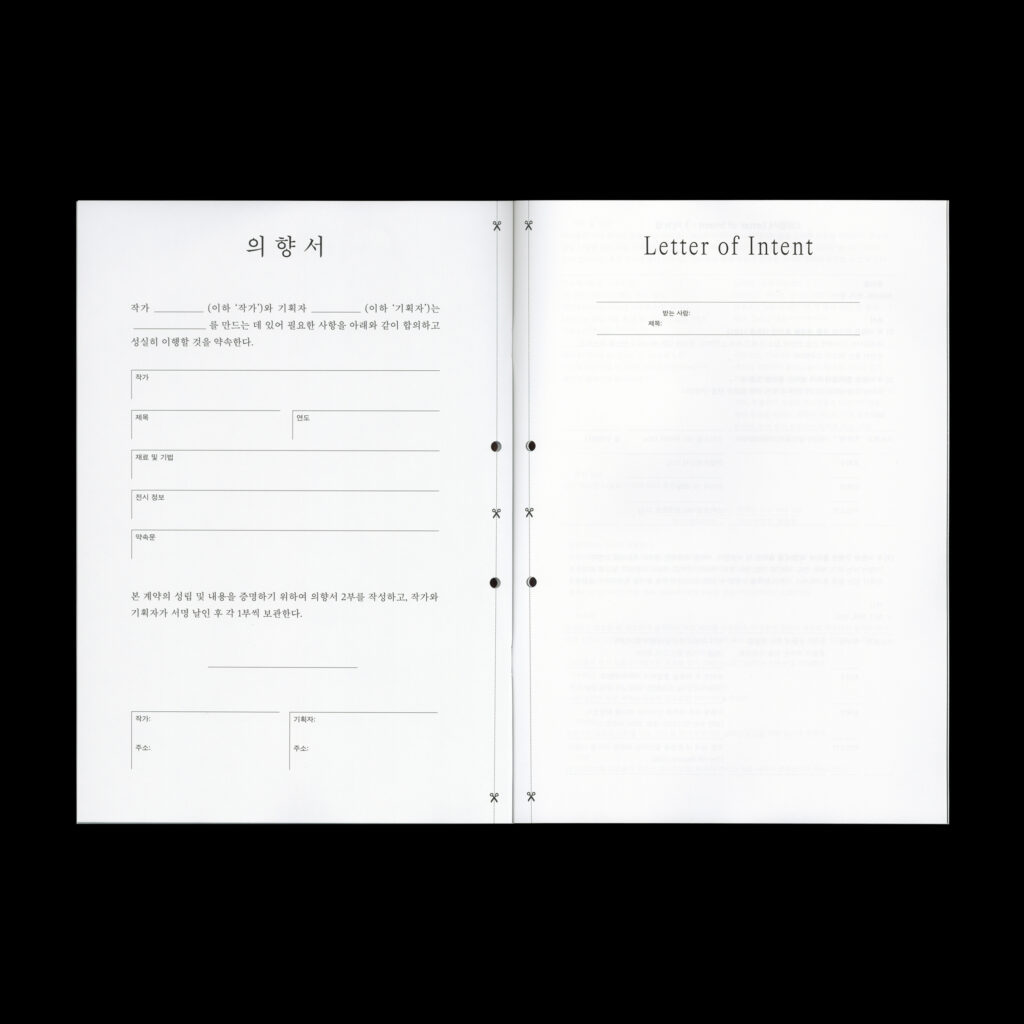
또 하나 흥미로운 것은 이 책이 사적, 공적 관계의 경계를 탐색하는 데 그치지 않고, 매체와 물성이 서로 다른 형식으로 번역되고 확장되는 과정까지 함께 탐구하고 있다는 점이다. 같은 문서는 공간과 관계를 통과하면서 유기체처럼 새로운 역할과 의미를 만들어낸다. 큐레이터와 작가가 함께 고른 종이 한 장은 의향서가 되고, 서약된 의향서는 전시 공간을 거쳐 포스터가 되며, 섭외 편지는 리플릿이 된다. 그리고 그 모든 흔적은 다시 한 권의 책으로 묶인다. 책의 말미에는 누구나 다시 작성해 볼 수 있도록 빈 의향서가 열린 형식으로 수록되어 있다. 이는 독자에게 직접 참여를 제안하는 장치이자, 앞으로 이 작업에 함께할 새로운 참여자들을 향한 초대장처럼 기능한다. 그렇게 엮어진 책에서 표지에 제시된 1부터 5번까지의 매뉴얼은 이 책이 어떤 방식으로 읽히고, 또 어떻게 실현되기를 바라는지를 예고하는 선언처럼 기능한다. 중철 제책 위에 더해진 펀칭 역시 이후 작성될 또 다른 의향서들이 이 책에 계속 덧붙여지고 축적되기를 염두에 둔 구조처럼 읽힌다. 그렇게 『의향서들』은 하나의 완결된 결과물이 아니라, 관계를 기록하는 문서이자 새로운 관계를 예고하는 열린 형식의 책으로 남는다.
이러한 구조는 저자가 큐레이터 자신의 위치에서 직접 책을 썼기에 더욱 선명하게 드러난다. 이 책이 수행하는 개념적 역할을 저자 스스로 충분히 설명하고 있는 만큼, 형식 하나하나에도 보이지 않던 관계의 이면을 기록으로 옮기고, 독자에게 다시 사유를 제안하려는 의도가 자연스럽게 스며 있는 듯하다.
돌이켜보면 최근 사업자등록을 하고, 『강철의 연금술사』의 깊은 여운과 함께 맴돌던 생각들은 『의향서들』이 던지는 주제 의식과 묘하게 맞닿아 있다. 회사라는 체계적인 울타리 밖에서의 협업은 사적인 자아실현이라는 가치와 공적인 심리적, 물질적 보상이 좀처럼 분리되지 않는 영역이다. 기획과 제작에는 분명 전문적인 노동이 요구되지만, 그 안에는 개인적으로 하고 싶은 일에 대한 애정과 팀원 간의 신뢰, 개개인이 함께 이루고 싶은 이상 역시 깊게 개입되어있다. 그러다 보니 보상도, 미래에 대한 보장도 없는 일을 기꺼이 떠안게 되는 순간도 적지 않다. 그럼에도 이 일을 계속 ‘함께’하게 만드는 데에는 계약이나 손익만으로는 설명하기 어려운 요소들이 분명 존재한다. 공적인 영역에 속하지만, 경계가 다소 흐릿한 시간을 함께 보내며 쌓인 신뢰와 동질감, 함께였기에 가능했던 시행착오와 경험, 그리고 다시 함께 무언가를 도모해 볼 수 있다는 감각 같은 것들 말이다. 어쩌면 그런 것들이야말로 시스템 밖에서 협업을 지속하게 만드는 조건인지도 모른다.
얼마 전 사업자등록을 위해 작성했던 사업의 조건들로 채워진 딱딱한 서류 어디에도 협업을 위한 진짜 연성 조건은 적혀 있지 않았다. 『의향서들』은 그 생략된 약속을 다시 한번 생각하게 한다. 문제를 하나씩 해결해 나가는 과정에서 쌓인 신뢰, 적당한 빈틈을 견뎌주는 마음, 완벽하지 않아도 함께라면 해결할 수 있다는 믿음, 등가교환만으로는 설명할 수 없는 그런 가치들….
CC 라이브러리에 모인 책들은 안전한 방식을 답습하기보다, 의도적으로 익숙한 길을 비켜나 새로운 의미를 집요하게 사유하는 과정에서 탄생한, 그 존재만으로 비평적 디자인의 역할을 수행하는 책들이다. 제작자가 내용뿐 아니라 기획에서부터 제책 방식까지, 제작 과정 전반에 적극적으로 개입해 디자인된 대부분의 책은, 안전한 영역을 벗어나려는 시도 자체를 하나의 태도로 삼는다.
그래서 이 서가의 책들은 조금 다르게 읽힌다. 빽빽한 책장에 빼곡히 꽂혀 있기보다 주제도 크기도 두께도 제각각으로 듬성듬성 놓인 테이블 위에서, 각각의 책들은 새로운 관점을 제시하고, 지적인 즐거움을 건네며, 때로는 창작의 동기를 불어넣을 만반의 준비를 갖추고 독자와의 만남을 기다리고 있다. 앞으로 월 1회, 이 서가에서 만난 반짝이는 책들을 한 권씩 함께 들여다보며, 그 즐거움을 조금씩 나누어보고자.
Translated automatically into English via AI agent.
It has now been two years since we started running a mobile library called bookeubookeu①❶bookeubookeu(부/끄/부/끄) is a mobile library based in Seoul. It curates distinctive sources of inspiration and knowledge that are not easily found online, introducing them through offline events and editorial content. The project aims to create an open space where anyone can freely share ideas, exchange knowledge, and build meaningful connections. bookeubookeu is run by Kim Yongsik, Jang Jaehyeok, and the author, Han Ji-eun. Along the way, we found ourselves taking on all kinds of projects—often without much of a plan—and somehow managing to see each one through. Before we knew it, we had even registered it as a business. When we first began, with no grand mission and little prospect of making money, I never imagined it would lead to something as official as a business registration. It all started rather casually, somewhere between work and play, simply because we wanted to make something together. But after spending countless hours on work that offered little immediate reward, I sometimes found myself asking, Why are we doing this? What exactly are we working toward?
I still don’t have a satisfying answer to those questions. What I do know is how rare it is to find people you can truly work with. Sharing similar tastes is one thing; finding people with whom you can continue building something over time is another. What began as a loose agreement gradually became a team, perhaps because we kept working through both small and large challenges together, slowly building trust along the way. Simply having teammates to share the work with is often enough to quiet questions like Why are we doing this? If I had to give one reason, it might be this: we wanted to publish a book with an ISBN. The three of us signed the paperwork to register the business for that purpose. Nothing really changed afterward, but that single sheet of paper somehow made it feel as though we had quietly promised to keep doing this together for a while longer.
Our mobile library, bookeubookeu, has taken the form of a series of temporary libraries in different places. Visitors bring a book and exchange it for another, one book for one book. At first, I secretly worried that people would simply bring books they wanted to get rid of. Instead, many chose books that had genuinely meant something to them. Discovering a stranger’s bookshelf through those exchanged books became one of the most rewarding parts of running the library, and we hoped visitors would experience that same sense of discovery. Recommendations naturally followed—books passed from one person to another, stories shared alongside them. Not long ago, someone I met through the library insisted that Fullmetal Alchemist was a book “you can’t call yourself cultured without reading.” Thanks to that enthusiastic recommendation, I finally picked it up years after its release. It immediately became one of the most memorable things I had read in recent years, and I understood at once why they had recommended it so passionately.
In Fullmetal Alchemist, two brothers who lose their bodies through the forbidden practice of alchemy set out on a journey to recover what they have lost. The story is built upon the principle of the law of equivalent exchange: to gain something, something of equal value must be given in return. Yet although the brothers believe in that principle more than anyone else, they repeatedly choose to accept loss when it matters most. What the story ultimately suggests is that even a law as fundamental as equivalent exchange loses its power in the face of genuine care between people. In that sense, its logic feels surprisingly close to our own world. Our mobile library also operates on the simple rule of one book for another, but what we truly hope for may be something that cannot be measured at all: the unexpected encounters that happen along the way.
Letters of Intent is a book that quietly reveals the unique relationships that emerge in the art world, where personal affection and professional labor are often inseparable. I have encountered many projects that elevate collaboration into a kind of artistic manifesto—from the networked publications of Dada and Fluxus to Hans Ulrich Obrist’s participatory publishing project Do It, which reimagined publishing not as a record of artworks but as a catalyst for new forms of practice and collaboration. Yet I had rarely encountered a work that so openly records the subtle emotions exchanged as relationships take shape, along with the still-unnamed state that exists before a relationship settles into a recognizable form.
The structure of the book is remarkably straightforward. It begins with a manual printed on the cover, followed by four Letters of Intent jointly written by the curator and the four participating artists—Ik Soo Kaay, Choi Hee su, Hyeyeon Kim, and Leebinsoyeon—for the exhibition. These are followed in turn by the emails exchanged during the invitation process, transcripts of conversations with the artists, documentation of the exhibition itself, and finally a blank letter of intent that readers are invited to complete on their own.
More than anything, what reveals the book’s intentions is its decision to give written form to the expectations, commitments, and promises that are usually exchanged only verbally before a collaboration formally begins. In Letters of Intent, curator and author Lee Borum turns her attention to the ambiguous emotions and provisional state she calls “intent”—the space that exists before a contract is signed—and to what she describes as the “collusive friendship” between curator and artist, positioned somewhere between an official document and a personal letter. To explore this idea, she adopts the format of the letter of intent, a document more commonly associated with real estate or investment, where it is used to express a willingness to proceed before a formal agreement is made. Here, the letter of intent is not a legally binding contract. Instead, it serves as a device for recording and making visible the beginning of a relationship that might otherwise dissolve as easily as spoken words. As a result, these letters contain a kind of promise rarely found in conventional contracts.
“Work only within the limits of your strength. Do not exhaust yourself completely,”“Do not rush to conclusions. Every work is a complex organism with a life of its own,”“Even when our perspectives and directions do not align, it is enough simply to remain by one another’s side.”
Promises like these—less contractual obligations than shared commitments between people working together—reach beyond financial terms or formal agreements. Instead, they reveal the conditions under which relationships are sustained: how people care for one another, support one another, and continue working together.
The texts that follow are at once invitation emails and personal letters. They bring together the professional labor of proposing an exhibition as a curator, the affectionate observations that can only come from someone who has followed the work of these four artists over many years, and thoughtful interpretations of their practices. In doing so, they once again reveal the point where the personal and the professional naturally converge. Although these conversations take the relatively formal form of email, they retain the warmth of letters written in the spirit of a relationship. Near the end of each email, a brief note gently asks the artists to participate in the exhibition without compensation, apart from the minimum travel expenses. The request is understated, yet it quietly reveals that their collaboration rests not simply on contractual obligations, but on mutual trust and what Lee calls “collusive friendship.”
Another compelling aspect of Letters of Intent is that it does more than explore the blurred boundary between personal and professional relationships. It also traces how ideas move across different media and material forms, continually transforming as they do. The same document takes on new roles and meanings as it passes through different spaces and relationships, almost like a living organism. A single sheet of paper chosen by the curator and artist becomes a letter of intent. The signed letter of intent becomes a poster as it enters the exhibition space. The invitation letter becomes a leaflet. In the end, all of these traces are gathered together in the form of a book. At the back of the book, readers are invited to write their own letter of intent using a blank template. It functions both as an invitation to participate and as an open gesture toward future collaborators who may one day become part of the project. Read in this light, the five instructions printed on the cover serve almost as a manifesto, anticipating not only how the book should be read, but also how it hopes to be put into practice. Even the punched holes added to its saddle-stitched binding seem designed with future additions in mind, as if new Letters of Intent could continue to be inserted and accumulated over time. In this sense, Letters of Intent is not a finished object, but an open-ended publication: a document that records relationships while simultaneously making space for new ones to emerge.
This structure becomes all the more compelling because the book is written by the curator herself. Since Lee Borum clearly articulates the conceptual role the publication is meant to play, every formal decision seems imbued with the intention of bringing previously invisible relationships into the realm of documentation, while inviting readers to reflect on them anew.
Looking back, I realize that many of the thoughts that lingered after registering our business—and after finishing Fullmetal Alchemist—unexpectedly echo the questions raised by Letters of Intent. Collaboration outside the framework of an established institution is a space where personal fulfillment and professional, emotional, and material forms of compensation rarely exist as separate concerns. Planning and producing a project undoubtedly require professional labor, but they are equally shaped by affection for the work itself, trust between collaborators, and the ideals people hope to pursue together. As a result, there are many moments when we willingly take on work that offers neither immediate reward nor any guarantee of the future. And yet there is something that continues to make us do this together—something that cannot be explained by contracts, profit, or equivalent exchange alone. It is the trust built through time spent together in the blurred space between the personal and the professional, the shared experiences and failures that only became possible through collaboration, and the feeling that we can continue imagining new projects together. Perhaps these are the very conditions that make collaboration possible beyond the systems that seek to define it.
The formal documents we prepared for our business registration were filled with conditions and requirements, yet nowhere did they describe the conditions that truly sustain collaboration. Letters of Intent reminds us of those unwritten promises: the trust accumulated through solving problems together, the generosity to leave room for one another’s imperfections, the belief that things can be worked out as long as no one is facing them alone—values that cannot be accounted for through equivalent exchange alone.
The books gathered at the CC Library deliberately avoid familiar and reliable paths. Instead, they emerge from persistent attempts to step outside convention and think through new possibilities. By their very existence, they function as works of critical design. Their makers are deeply involved not only in the content of each publication, but in every stage of its production—from the initial concept to the choice of binding—treating the act of moving beyond safe territory as a creative attitude in itself.
Perhaps that is why the books on these shelves ask to be read differently. Rather than standing neatly aligned on tightly packed bookshelves, they rest loosely across tables, each varying in subject, size, and thickness. Each offers a different way of seeing, the pleasure of unexpected ideas, and sometimes even the spark for making something new. Beginning with this essay, I hope to spend time with one remarkable book from this library each month, sharing some of the curiosity and delight they have given me.
Writer
한지은Han Jieun
그래픽디자인과를 졸업한 뒤 에디터로 일했다. 이후 다시 그래픽 디자인을 공부하고 싶어 진학한 대학원에서 한국 진(zine) 문화를 주제로 석사 논문을 썼다. 좋아하는 일을 공부하고, 재미있게 하면서 먹고사는 방법을 고민하고 있다.Han Jieun studied graphic design before working as an editor. She later returned to graduate school to continue her studies in graphic design, where she completed her master's thesis on Korean zine culture. She is interested in finding ways to build a life around the work she loves—continuing to study it, enjoy it, and make a living from it.